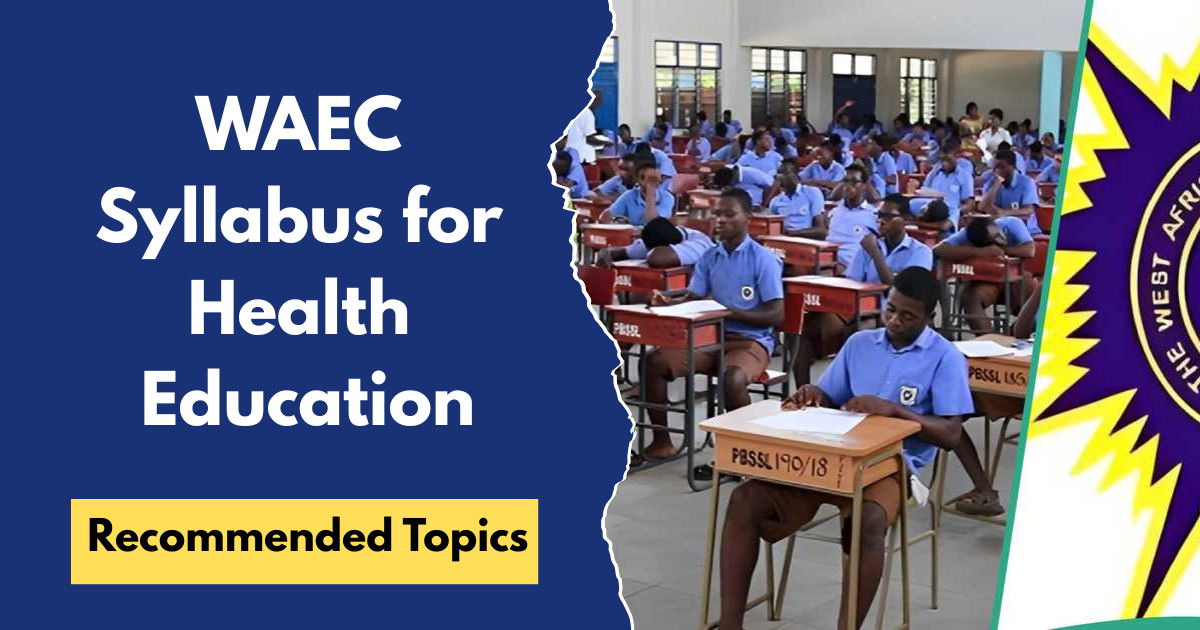
WAEC Syllabus for Health Education
Are you preparing for the WAEC Health Education examination and looking for the official syllabus? If yes, then you are in the right place.
The WAEC syllabus for Health Education is one of the most important study materials every candidate should have. It outlines all the topics you are expected to study before the examination, helping you focus on the areas that matter instead of reading randomly.
In this article, you will find the complete WAEC Health Education syllabus, the examination scheme, and the recommended textbooks to guide your preparation. If you study these topics carefully and practise consistently, you will be well-prepared for the examination.
WAEC Syllabus for Health Education
| Section / Topic | Notes |
|---|---|
| A. History and Development of Health Education | |
| 1. Meaning and Setting for Health Education | Students should visit and observe community-based, health facility-based, and workplace-based health education programmes and services. |
| B. Human Anatomy and Physiology | |
| 1. Cells and Tissues of the Human Body | Structure of a typical animal cell and the functions of its parts should be discussed. Differences between mitosis and meiosis should be emphasized. Mention should be made of epithelial, connective and muscular tissues. An organ and a system should be explained. Differences between growth and development should be emphasized. Factors affecting growth and development should be discussed. |
| 2. Sense Organs | Accommodation of the eye should be discussed. The process of hearing and balancing should be discussed. |
| 3(a). Skeletal System and Muscles | A chart or model of the human skeleton should be examined. Types of bones should be identified. Emphasis should be placed on synovial joints. The location of different types of joints should be identified. Specific examples should be used to illustrate the classes of levers. The three types of muscles should be discussed in relation to their functions. Reference should be made to the origin and insertion of muscles in relation to movement. |
| 3(b). Circulatory System | Candidates should examine the heart of a dissected mammal. Pulse rate should be counted. The web of a toad or frog should be examined with a hand lens to observe capillaries. The importance of lymph nodes should be mentioned. Prepared slides of blood should be observed under a microscope. Pulmonary and systemic circulation should be emphasized. The relevance of blood groups, rhesus factor, haemoglobin and genotype to blood transfusion should be mentioned. The hereditary aspects of sickle cell anaemia and haemophilia should be discussed. Prevention of anaemia and arteriosclerosis should be discussed. |
| 3(c). Digestive System | Candidates should examine the alimentary canal of a dissected mammal. The location and functions of accessory digestive organs should be emphasized. Digestive enzymes should be discussed in relation to substrates and end-products. Tissue respiration should be mentioned in relation to metabolism. Osmosis and diffusion should be demonstrated, and their importance in absorption emphasized. The importance of proper eating habits and the effects of overeating and undereating should be discussed. |
| 3(d). Excretory System | Candidates should examine the urinary system of a dissected mammal. Prepared slides of the skin should be observed under a microscope. Reference should be made to the excretory function of the lungs. The use of dialysis machines for kidney failure should be mentioned. |
| 3(e). Respiratory System | Candidates should examine the respiratory organs of a dissected mammal. Experiments should demonstrate inhalation and exhalation of air. Total, complementary and residual air should be explained. An experiment should show that expired air contains more carbon dioxide and water vapour. |
| 3(f). Nervous System | The brain, spinal cord and nerves should be discussed. The reflex arc should be studied. |
| 3(g). Endocrine System | Characteristics of endocrine glands should be mentioned. Charts or models should be used to study the location of the glands. The effects of over-secretion and under-secretion of hormones should be emphasized. |
| 3(h). Homeostasis | Body temperature, blood sugar level, water balance, electrolyte balance, pH and blood pressure should be highlighted. Candidates should test urine with litmus paper and count pulse rate. Mention should be made of positive and negative feedback control systems. |
| 4. Posture and Postural Defects | Posture should be related to sitting, standing, walking and lifting. The roles of nutrition and exercise in maintaining correct posture should be discussed. Causes of postural defects, such as habits, accidents, heredity and diseases, should be discussed. The roles of orthopaedic hospitals and physiotherapy units in correcting postural defects should be mentioned. |
| C. Personal Health | |
| 1. Meaning and Importance of Physical Health | Care of body parts, including the teeth, mouth, hair, hands and nails, should be discussed. |
| 2. Personal Hygiene | Care of the body and personal cleanliness should be emphasized. |
| 3. Promotion and Maintenance of Health | Factors that promote and maintain good health should be discussed. |
| 4. Health Screening | The use of the Snellen chart for vision screening should be mentioned. The roles of eye specialists in correcting eye defects should be discussed. Otitis media should be mentioned. The use of a tuning fork, audiometer, guitar strings and wristwatch in hearing tests should be mentioned. Sign language should also be mentioned. |
| 5. Dental Health Education | The structure and functions of the different types of teeth should be discussed. Dental caries and gingivitis should be mentioned. |
| D. Community Health | |
| 1. Community Health Services | Advantages and disadvantages of traditional medicine should be mentioned. Awareness campaigns should be discussed. |
| 2. School Health Programme | Both the physical and biological school environment should be discussed. |
| 3. Family Health | Antenatal care, immunization, Oral Rehydration Therapy (ORT), breastfeeding and safe motherhood should be discussed. |
| 4. Ageing and Death Education | Appropriate ways of relating with the elderly should be emphasized. |
| 5. Epidemiology and Vital Statistics | Candidates should be able to define epidemiology, vital statistics and population dynamics. The importance and use of health records should be stressed. |
| E. Environmental Health | |
| 1. Housing | The effects of poor sanitation and pest infestation in the home should be discussed. The effects of substandard housing on health should also be discussed. |
| 2. Water Supply | Sources include rain, boreholes, rivers, streams, springs, wells, ponds and pipe-borne water. The advantages and disadvantages of each source should be discussed. |
| 3. Waste Disposal | Proper methods of waste disposal should be emphasized. |
| 4. Pollution | The causes, sources and health effects of pollution should be discussed. |
| 5. Industrial Occupation | The need for healthcare, rehabilitation and health insurance schemes should be discussed. |
| 6. Pests and Vectors Control | Students should be able to identify and differentiate between pests and vectors. |
| F. Nutrition and Food Nutrients | |
| 1. Nutrition | Tests for starch, simple and complex sugars, proteins and fats should be carried out. Local examples of food nutrient sources should be mentioned. Caloric needs should be discussed in relation to age, occupation and health status. |
| 2. Balanced/Adequate Diets | Food deficiency diseases should be emphasized. Factors responsible for unbalanced diets and their effects should be discussed. |
| 3. Factors Influencing Feeding Habits/Choice of Foods | Factors such as availability, religion, education, age, beliefs, health condition and cost should be discussed. |
| 4. Water | The role of water in nutrition should be discussed. |
| 5. Nutritional Processes | The processes of ingestion, digestion, absorption, assimilation, metabolism and egestion should be explained. |
| 6. Beverages | The nutritional value of non-alcoholic beverages should be emphasized. The positive and negative effects of beverages should be discussed. |
| 7. Diet for Different Groups of People | Charts should be used to illustrate diets suitable for different groups of people. |
| 8. Food Hygiene, Preservation and Storage | Food handling, cleanliness of cooking utensils and surroundings should be discussed. The effects of poor food handling should be stressed. The effects of washing, boiling, frying, baking and roasting on nutrients should be discussed. |
| G. Safety Education and First Aid | |
| 1. First Aid | Candidates should know the contents and uses of a first aid box, treatment of common emergencies and agencies that provide first aid services. |
| H. Drug, Alcohol and Tobacco Education | |
| 1. Drug Education | Drug abuse, drug dependence, drug misuse, drug addiction, self-medication, alcoholism and rehabilitation should be mentioned. The routes of drug administration include oral, injection, inhalation, topical and anal. Prevention of drug abuse should be emphasized. |
| 2. Behaviour Altering Chemicals | The health effects of tobacco, alcohol and other drugs should be discussed. |
| I. Communicable and Non-Communicable Diseases | |
| 1. Diseases | Candidates should understand the meaning and classification of diseases. |
| 2. Communicable Diseases (Air-borne/Respiratory Diseases) | The life cycle of the pathogen responsible for each disease should be discussed. The life cycle of each worm should also be discussed with the aid of charts where applicable. |
Recommended Textbooks for WAEC Health Education
The following textbooks are recommended for candidates preparing for the WAEC Health Education examination:-
- Comprehensive Health Education for Senior Secondary Schools by A. O. Akande and others.
- Health Education for Senior Secondary Schools by the Nigerian Educational Research and Development Council (NERDC).
- Essentials of Health Education by O. A. Odujinrin and colleagues.
- New School Health Education by Macmillan Nigeria Publishers.
- Senior Secondary Health Education by University Press PLC.
If you found this article helpful, share it with other WAEC candidates who are preparing for Health Education. If you have any questions about the syllabus or the examination, drop them in the comments section, and we'll be happy to help.